
.png)
The knowledge that actually runs government lives in inboxes, all-hands calls, and thirty-year veterans — Roundtable AI captures all of it

Most consumer AI tools know what's published online. They'll pull the latest policy guidance from a federal website, summarize the official FAQ, and tell you what the rulebook says. In a hectic online world where even the most basic information retrieval feels like a chore, off-the-shelf AI tools have utility.
But any public servant who's been on the job more than a few weeks knows that the rulebook is only part of the story. Real government work runs on far more information — data that’s rarely captured in structured government databases.
Ask a thirty-year veteran what’s “true” and read the rulebook about what’s “true” and there will be a gap. You’re bound to get different answers. We think about that gap as representative of “layers of truth.”
For AI to actually work in a government context, it needs information from official guidance, internal communications, and human intelligence. We’ve built Roundtable AI upon all three layers of truth to ensure public servants get the most accurate, actionable information possible.
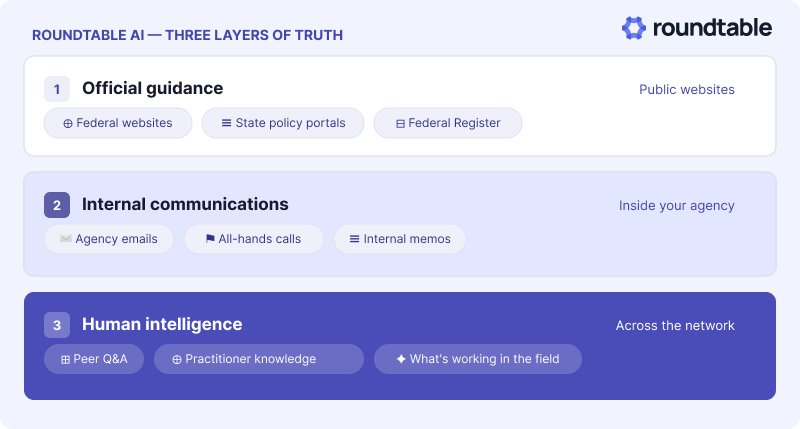
Official guidance is composed of federal and state policy documents, grant guidelines, and program rules. These get updated constantly, and keeping up is a job in itself. Roundtable’s AI pulls the latest from external sources automatically, so as long as the official guidance itself is up to date, public servants get the latest.
This is a helpful foundation, but for public servants on the front lines, official guidance alone doesn’t provide all the information required to translate policy into practice. Public servants are often adapting official guidance to their operational ground truth, which is where layers two and three come into play.
Think about all the memos, directives, and unofficial guidance agency leadership provides regarding implementation of a policy. Think about what a director said on an all hands call, or what a state official clarified in an email.
That context lives inside your organization, not on any public website. Off the shelf AI tools require a lot of technical work from IT in order to be configured properly to capture this information — time and technical work most government agencies can’t afford.
Roundtable AI can surface this information too, right “out of the box.” No special IT legwork required.
This is where most off-the-shelf AI tools really fall short. How are other agencies actually spending allocated funds? What's working in the field versus what looks good on paper? Traditionally, that knowledge travels by word of mouth, which means it travels slowly, unevenly, and it disappears when someone retires. It’s not often captured digitally.
Roundtable AI captures the third layer, too. Peer discussions across the Roundtable network — the questions, the answers, the shared experience of thousands of public servants doing the same work in different places — become part of the knowledge base that AI draws from. It's not just what the policy says. It's what people have actually learned about how to use it.
And in the instances when the answer hasn't been captured digitally at all, Roundtable AI points the government employee to the people most likely to know. This is where Roundtable AI’s secret sauce shines: It knows if the right source of context is a federal register, an agency database, or in the institutional memory of someone who's been in the room. It always helps users take the next step, ask the next question, or identify the next person, accelerating how government work is done without changing the context and workflows public servants are used to.
Some tools stop at the official document.
Roundtable AI captures the richer context of how the world of the public servant actually looks.
Subscribe to our monthly newsletter below.