
.png)
Policy doesn’t implement itself. The outcomes depend on staff across local governments, frontline providers, nonprofits, and beyond knowing what they need to run programs.
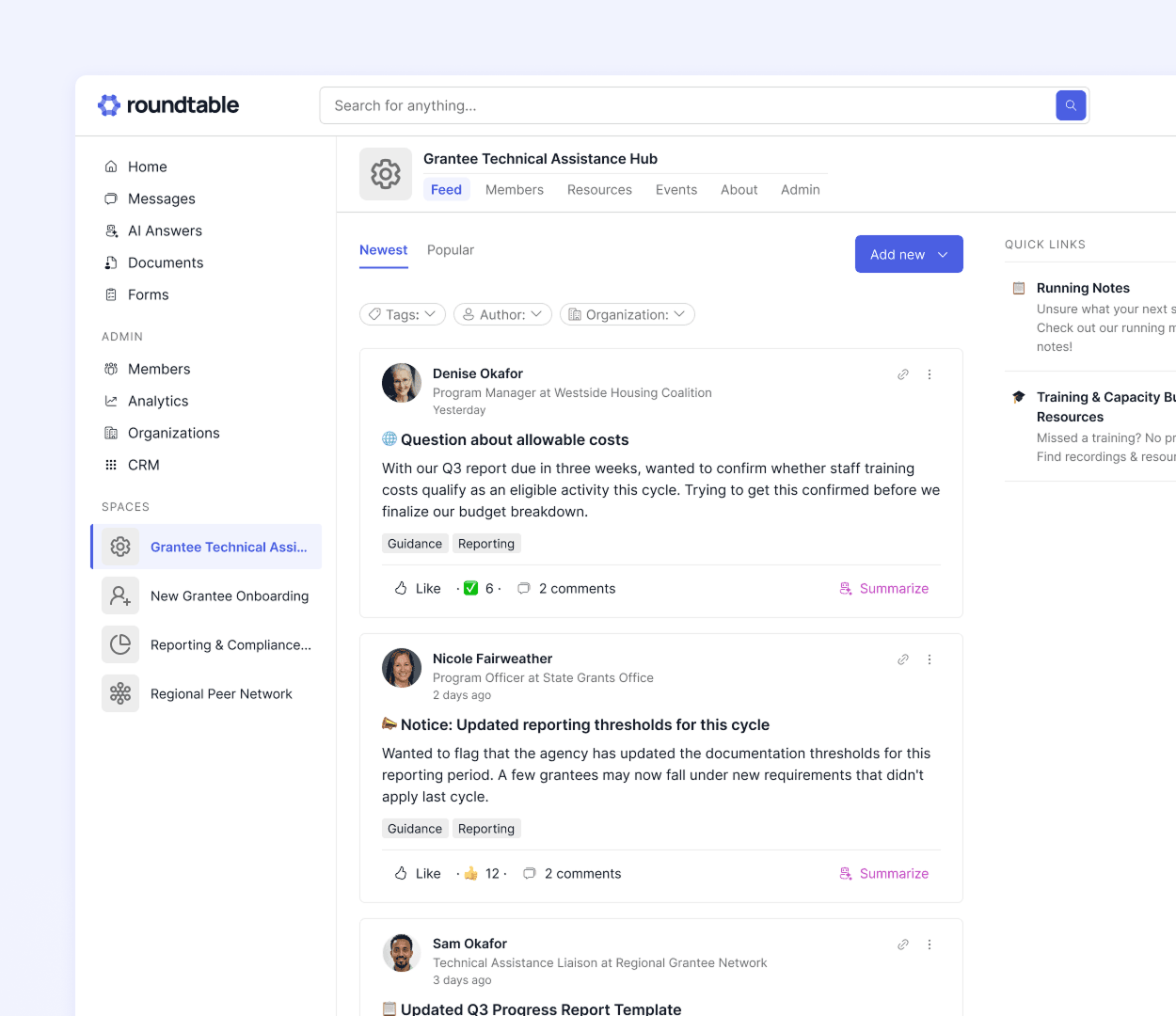
When legislatures pass laws, funding is awarded, or new priorities are announced, state agencies become responsible for turning policy into real-world outcomes. States, however, rarely do this work alone. Implementation depends on local governments, nonprofits, community organizations, grantees, contractors, and frontline staff applying new guidance consistently in communities across the state.
Technical assistance is how agencies make that happen. It equips practitioners with the guidance, training, answers, and ongoing support they need to interpret policy, navigate difficult cases, and adapt as requirements evolve.
That responsibility has never been more challenging. Agencies are implementing increasingly complex programs while navigating staff turnover, budget constraints, and rising expectations for accountability. New federal requirements. including major operational changes introduced through H.R. 1. are forcing agencies to quickly update program rules, retrain partners, and ensure consistent implementation across thousands of organizations.
.png)
The goal isn’t delivering more trainings or publishing more guidance, it's ensuring every practitioner can access the right information, ask questions, and apply policy correctly at the moment they need it.
When technical assistance succeeds, programs are implemented consistently, funding is protected, and people receive services faster. When it falls short, errors increase, implementation slows, and agencies often discover problems only after deadlines are missed or formal reviews begin.
State agencies already possess enormous expertise. The problem is that traditional methods for sharing it with partners weren’t designed to support hundreds or thousands of people across organizational boundaries.
Technical assistance still relies heavily on one-time trainings, lightly attended webinars, PDF attachments, office hours, listservs, and long email chains. As programs grow, agency experts become bottlenecks. Staff repeatedly answer the same questions, while some organizations never receive the help they need.
Support also tends to disappear precisely when practitioners need it most: while interpreting guidance, working through an edge case, or adapting to a new requirement. Useful answers remain trapped in inboxes. Training gets buried in shared drives. Hard-won knowledge leaves when staff or consultants do.
Meanwhile, agency leaders have limited visibility into who is engaged, what questions are emerging, or where implementation is breaking down. Too often, they learn about a problem only after a deadline is missed or a formal review begins.
Scaling technical assistance cannot simply mean scheduling more webinars or adding more expert hours. Agencies need a delivery model that makes support targeted, accessible, persistent, and measurable, and turns every interaction into knowledge the entire network can use.
At Civic Roundtable, we believe the future of technical assistance is continuous, connected, and embedded in the work itself. The goal isn’t to deliver more trainings or publish more guidance, it’s to ensure that every practitioner can find trusted answers, connect with the right experts, and apply policy consistently when it matters most.
In the strongest technical assistance programs, every question strengthens the system, every answer becomes reusable knowledge, and expertise flows across organizations instead of remaining trapped in inboxes or individual staff. As government programs grow more complex and increasingly depend on networks of agencies, providers, nonprofits, and local partners, technical assistance must evolve from a series of one-time activities into a shared operational capability that scales with the work.
.png)
Roundtable gives agencies one secure platform to reach the right people, centralize trusted resources, deliver instant answers, activate peer expertise, preserve institutional knowledge, and understand implementation as it happens. Most importantly, Roundtable makes critical guidance easier to find and support available when it’s needed most.
To date, agencies using Roundtable have connected more than 5,000 organizations, reduced repetitive communications by more than 80%, and saved staff hours each week.
Across the country, agencies are building new ways to deliver guidance, answer questions, and support implementation across organizational boundaries. Their work shows what technical assistance looks like when it becomes continuous, scalable, and built around practitioners’ needs.
The Georgia Technology Authority is connecting more than 90 state agencies to coordinate statewide digital accessibility improvements ahead of federal compliance deadlines. While GTA lacks management authority over the websites of every state agency, they’re ensuring every agency webmaster has what they need. Shared guidance, real-time support, and engagement tracking have dramatically reduced repetitive follow-up: work that once took GTA a full day now takes just an hour.
The New York State Board of Elections provides ongoing technical assistance to election commissioners across 62 counties. Instead of sending an answer to one official at a time, NYSBOE is broadcasting guidance across the state, connecting commissioners with peer expertise, and preserving questions and answers for the next person who needs them.
One federal agency is using Roundtable to support more than 1,500 state and county officials across all 50 states as they carry out critical public responsibilities. They’re centralizing resources from authoritative federal websites to PDF guides and trainings, and providing nationwide access in a shared knowledge base. Roundtable lets the agency scale communications across its national network for policy changes, distribute trusted guidance, surface best practices, and answer questions. With shared infrastructure, local leaders are learning from peers facing similar challenges.
These agencies are moving beyond point-in-time and one-to-one assistance. They’re creating continuous systems of support in which questions become searchable, trainings become reusable, local expertise benefits the broader field, and institutional knowledge grows over time.
Explore how Roundtable helps agencies deliver technical assistance at scale.

Subscribe to our monthly newsletter below.