

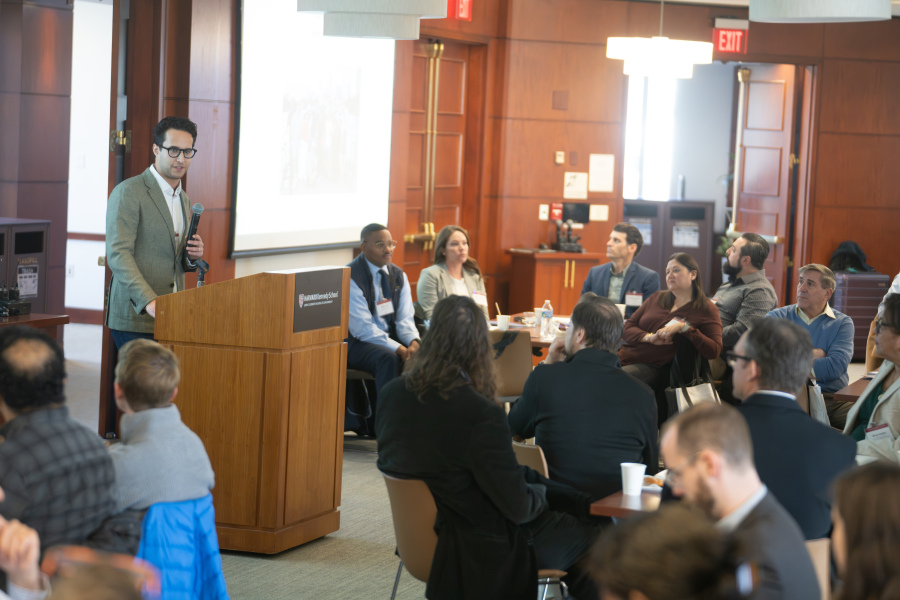
Despite an Outlook outage and an FAA outage the night before, nearly 60 public servants from across the country made it to Harvard Kennedy School on November 16 for our third annual Public Sector AI Summit. For most of them, a day away meant leaving behind full inboxes, growing backlogs and residents who still needed help. They came anyway, because the work they do is hard to do alone.
Civic Roundtable co-founder Austin Boral opened the day with three hopes for everyone in the room: leave with one idea to try, one person you're glad you met, and a sense that peers across the country care about your success. Here's what that looked like.
The morning started with a question that sounds simple and isn't: how do you lead when no one knows what AI will be able to do? Harvard Business School professor Mitch Weiss walked the room through planning for several possible futures at once instead of betting on one forecast, and turning a team's anxiety about AI into a list of decisions. His advice was practical: use the tools yourself, expect productivity to dip before it rises, and start measuring value before a legislature asks.
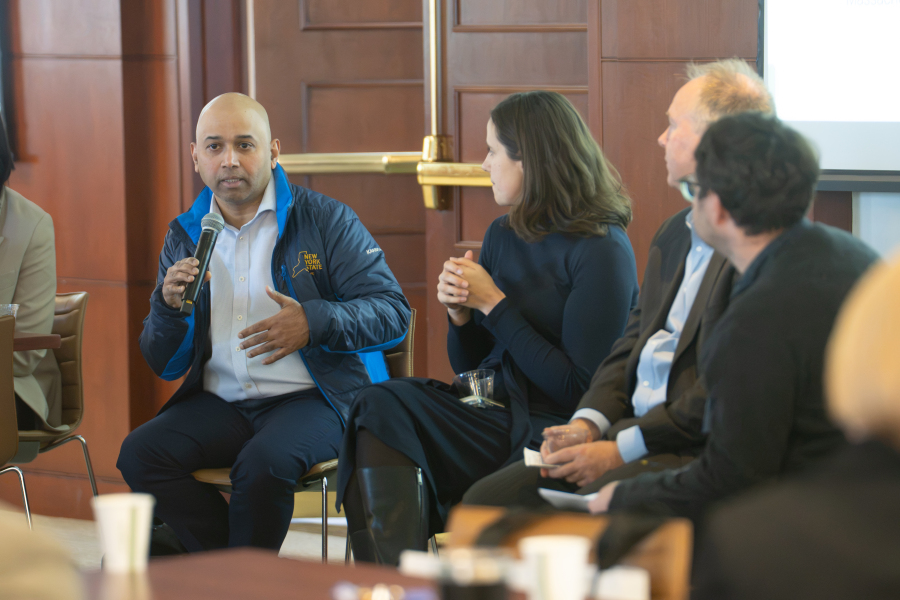
Then, three state CIOs: Jason Snyder of Massachusetts, Bry Pardoe of Pennsylvania and Jenson Jacob of New York, added a reality check. AI won't fix bad data or a broken process, and it isn't always the answer: New York is running some cutting-edge digital services with no AI at all. What lasts is the foundation work, technology built for the next decade, and the trust of the workforce.
The afternoon showed what's possible when public servants build. A New York State Department of Health leader turned a weekend prototype into a funded project. South Bend, Indiana is using city data to reach households before they fall behind on water bills. A Massachusetts GIS team used AI to map 50,000 structures for 911 routing, saving about six months of work. Connecticut, LA County and Marin County showed tools for hospital financial assistance, AI safety and resident engagement, each one shared as a work in progress, rough edges included.
Some of the most valuable moments of the day happened at our brain trust tables, where small groups worked through the problems keeping them up at night, from AI governance and data sharing to cost, security and labor relations.
At the table on employee and labor relations, leaders walked through exactly how their states built trust with the workforce: including making AI use voluntary, no tracking of employee prompts, and AI framed as a way to grow skills. A Colorado leader shared how peer champions spend a couple of hours a week helping colleagues in the same role. An Oregon leader described sitting down with the most skeptical union representatives first, on the theory that if you can convince them, you can convince anyone.
To close the day, volunteers shared what they think government will look like in 2036. A Massachusetts leader described a government residents barely notice: one connected experience, eligibility identified for you with your consent, and trust earned through the experience itself. A Maryland leader hoped proactive services arrive in two years, not ten. Harvard Kennedy School is planning for the same horizon. Dean Jeremy Weinstein closed the summit by sharing HKS 2036, the school's ten-year strategy, and asked the room to tell HKS what it's missing. The people closest to government's hardest problems are the ones best placed to shape what comes next.
No one left with every answer. They left with something more durable: new contacts in other states, specific answers to questions they'd been carrying alone, and examples they can adapt back home. They left knowing that the union conversation, the procurement challenge or the budget question in front of them has already been faced somewhere else, by someone willing to pick up the phone.
That's what makes a day like this worth the time. Public servants go back to their agencies knowing more about AI, and knowing who to call when the next hard question comes up.
That idea sits at the center of how we think about AI in government. Civic Roundtable co-founder and CEO Madeleine Smith opened the summit with the belief behind our work: government is a team sport. Progress on veteran homelessness, public health or emergency preparedness depends on working across agency lines, and much of that work happens in the space between agencies.

That space is also where time disappears. Public servants spend about a day a week looking for information they know exists. Our vision for AI is routing: when a public servant asks a question, AI should know whether the best answer lives in a document, a system of record, or the head of a peer three states away, and get them there. In an analysis of 10,000 questions asked in Roundtable, many, if not most, were answered with peer knowledge. The summit proved the same point in person. Our goal is to make that kind of connection available every day, not once a year.
Roundtable started because our founders saw, from inside and alongside government, how often the right answer depended on knowing the right person's cell number. Our mission is to bring the people, partners and knowledge behind every public mission into one place, and bringing public servants together in the same room is part of that work. We see it in New Jersey, where hundreds of organizations coordinate statewide to end veteran homelessness, and we saw it at Harvard Kennedy School, where public servants from across the country spent a day solving each other's problems.
Bringing new technology into government asks public servants to put their time, credibility and priorities on the line. Our job is to listen, follow through and earn that trust. Thank you to everyone who spent the day with us, and to Mitch Weiss, the Social Innovation and Change Initiative, HKS Executive Education and Harvard Kennedy School for helping make it happen. We'll see you next year, and we'll be checking which of the 2036 predictions came true.
Read the AI Peer Report on how public servants learn from each other, or see how Roundtable connects agencies and partners.
Subscribe to our monthly newsletter below.