

The CIOs of Massachusetts, Pennsylvania and New York expect AI to reshape how states build, buy and staff technology.

Predictions about AI in government usually start with the technology: what will models be able to do next year, and which tasks will they take over? State CIOs tend to start somewhere else. They oversee thousands of applications, statewide cybersecurity and the systems residents rely on every day, so they think about what has to be true for AI to work at that scale.
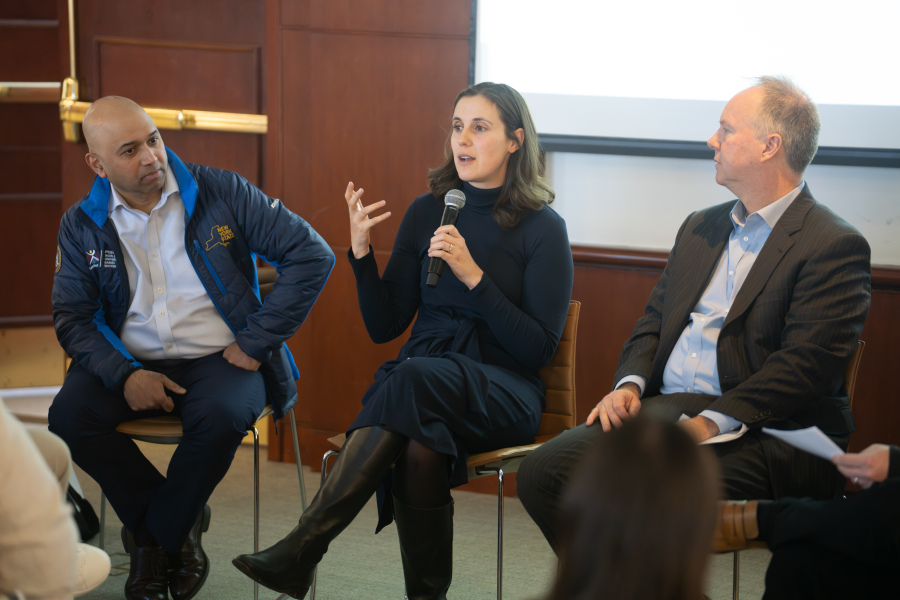
At our Public Sector AI Summit at Harvard Kennedy School, co-founder Josh Seiden asked three of them where AI in government is headed: Jason Snyder, Massachusetts Secretary of EOTSS and Commonwealth CIO; Bry Pardoe, Pennsylvania's CIO; and Jenson Jacob, New York's acting CIO.
In 1776, Massachusetts, Pennsylvania and New York helped draft the Declaration of Independence. In 2026, their CIOs had a few declarations of their own about AI. Their answers pointed to six shifts in the world of AI in government:
Much of the public conversation about AI in government assumes it will replace public workers. The group hadn’t yet seen evidence of that in state government. With budgets tight and backlogs growing, AI is taking on tasks, not entire roles. They expect the debate to turn on evidence, and want states to track AI's effects on jobs, education and communities and share what they find with each other.
The states that measure early will be the ones able to answer the question every legislature and union will eventually ask: what is AI actually doing here?
The most overrated AI pitch is any promise of a shortcut, like an agent that can map an entire state IT environment in a day. AI won't fix a bad process, and bad data with AI on top is still bad data. Pennsylvania is putting its effort into basics first: observability, standard intake and asset management.
The longer-term bet is a secure, consent-driven data exchange that connects the state's systems, so teams can build better resident experiences without waiting for every system to be replaced. Pennsylvania is building it with open-source patterns other states can reuse.
One of the most valuable reminders of the day was that good digital service doesn't always need AI. New York is already rolling out new digital services that cut processing time for permits and specific license renewals by 90% , all developed with no AI involved.
New York runs 4000+ applications from roughly 80 vendors, and their CIO wants the next generation of purchases to look different. He's asking vendors to pitch longevity and sustainability rather than features, because whatever ships today becomes legacy the day it launches. The goal is a standardized technology stack that holds up for 10+ years that agencies don't have to rebuild.
The other states are testing a prove-it approach to procurement where vendors work on site, learn the mission and show they can deliver in the state's real environment before a contract scales.
Much of the data states hold is regulated, from federal tax information to criminal justice records, and that limits which commercial tools can touch it. As open models get closer to the frontier, running AI inside state infrastructure is becoming a realistic option. For states, that shifts the question from whether they can use AI with sensitive data to how they govern it once they do.
All three CIOs described trust between leadership and teams as a crucial element for successful AI implementation. Different approaches could all work, and vary state by state. One state actively doesn't track employee prompts, another runs an AI collaboration workgroup with labor leaders.
Different state approaches also show the cost of moving too slowly. For New York, its technology office fields about 400 AI requests a week across 50 agencies, and blocking tools without offering alternatives pushes frustrated staff to work around the rules. To increase safety for all, the state is working on building a catalog of vetted, pre-approved tools that can be used by staff.
For the long-tenured CIOs, they have seen and experienced their role evolve over time. Where IT used to come to the policy table to assess the impact of decisions, now it often drives them. And, they describe much of the work as relationship management with budget, procurement, legal, the governor's office and cabinet. Another big aspect of the role: planning around the time-bound rhythm of an administration, and getting good at gauging when to ask for money, when to push, and when the window closes.
Jenson sees continuity as the missing ingredient. In 15 years at the state he has worked under seven CIOs, and he believes lasting change takes five or six years in the role, along with leaders who listen to their workforce and let innovation come from the bottom up.
The future these three CIOs described depends far more on clean data, durable infrastructure, written commitments to the workforce and relationships across agencies than on which model comes out ahead. Government is a team sport. The states that treat AI as shared work, across agencies, partners and the people who use the tools every day, will get the most out of it.
Read what public servants are learning from each other in our AI Peer Report, or see how state agencies coordinate across partners with Roundtable.
Subscribe to our monthly newsletter below.