
.png)
As both grantee and grantor, Nebraska is giving consistent, real-time guidance to the local partners it funds.
.jpg)
Nebraska’s Division of Public Health funds and supports various organizations across the state that deliver services in communities every day. They are a grantee and a grantor at the same time.
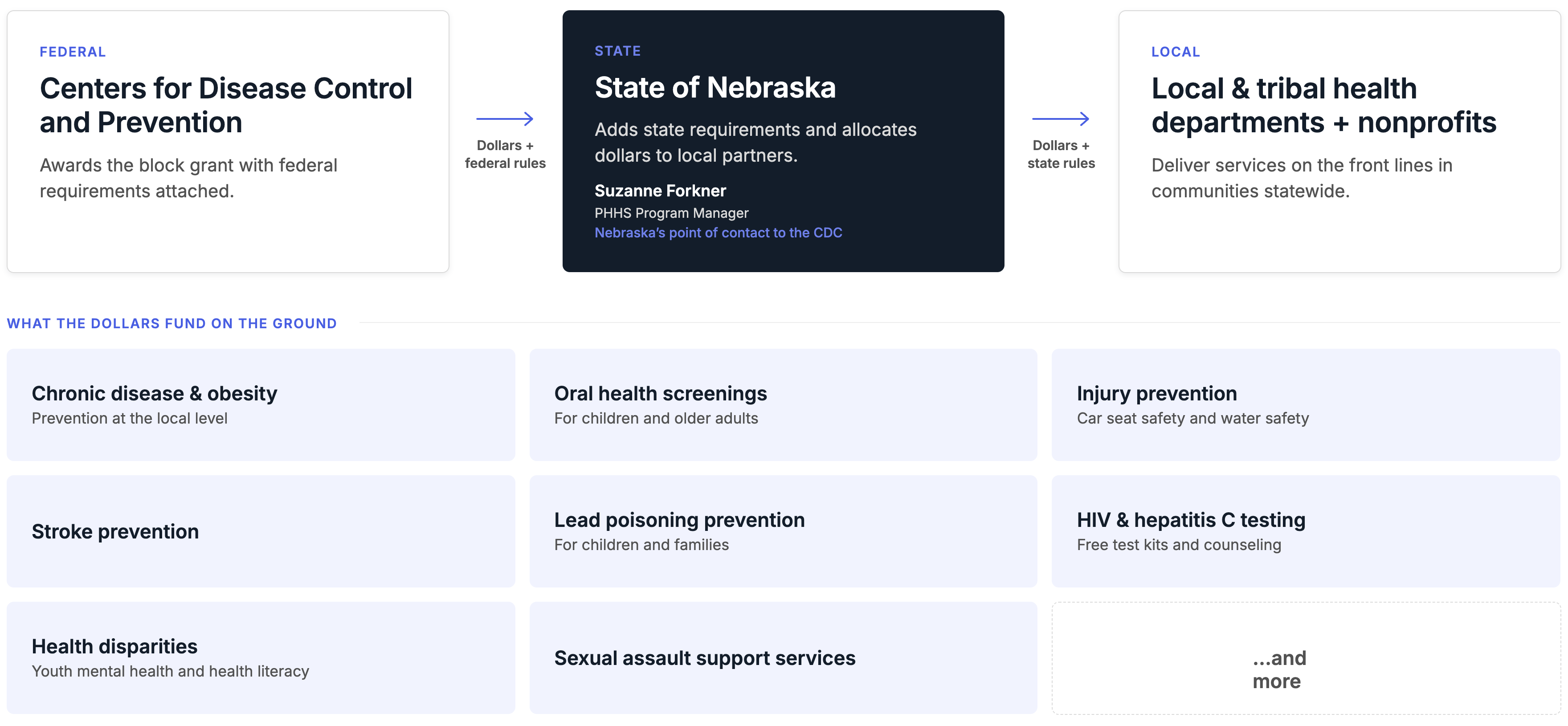
The Preventive Health and Health Services Block Grant arrives from the Centers for Disease Control and Prevention with federal requirements attached. Nebraska adds a layer of state requirements and allocates dollars down to local and tribal health departments and nonprofit partners on the front lines in communities across the state.
Suzanne Forkner, Preventive Health and Health Services Program Manager, manages that grant for the state and serves as Nebraska's point of contact to the CDC.
The breadth is difficult to convey quickly. "My work covers so many different topics," Forkner said. “Block grant dollars fund chronic disease and obesity prevention at the local level, oral health screenings for children and older adults, injury prevention work spanning car seat safety and water safety, stroke prevention, lead poisoning prevention for children and families, free HIV and hepatitis C test kits and counseling, health disparities work covering youth mental health and health literacy, sexual assault support services, and a lot more.”
She also works on public health accreditation support for local health departments — which Forkner describes as a good housekeeping seal of approval, the equivalent of what accreditation means for a hospital or a college — as well as managing data governance and public health data dashboards to share information with the public in a more modernized way. She also works on rural health, focusing on access to care and keeping healthcare providers in the communities that need them.
All in all, there are 20 internal state programs that reach countless organizations and people.
The reporting structure is where the scale becomes visible.
"One of my programs might have 20 subrecipients," Forkner explained. "So they have 20 reports coming into one report to me. And then I have 20 reports." More than 100 organizations are funded under the grants she oversees.
.png)
Local organizations report to state programs. State programs synthesize and report to Forkner. Forkner filters, aggregates, and reports to the CDC. Every year, the cycle includes an annual work plan and budget, a first-quarter report, an end-of-year report, and success stories — with template updates or scope changes typically landing three times a year, cascading across all 20 programs each time.
The scope and challenges relating to data collection and synthesis are clear.
Drilling down, Forkner identified two points in the grant cycle that consume the most time. The first is the front end: the initial work plan and budget. "That is necessary for success," Forkner said. Ensuring the state program’s vision aligns with CDC standards, budgets are on time and on track, and costs are allowable are vital. The second is closeout reporting, where the state has to roll local achievement up into a state-level picture of what was accomplished and how.
That roll-up is harder than it sounds. "We said we were going to reach a certain goal or threshold," Forkner said, "so we have to add up all the work at the local level to roll up to a state level."
Nebraska's baseline was an internal SharePoint page, and Forkner had built it carefully. She described it as tiered, organized, and comprehensive.
The problem was not the content. It was the physics.
"I put a lot of information and resources in the shared drive so it is there for folks to have access to," Forkner said. "But it is stagnant. It is there. You have to go to it. I cannot push people there, other than by email."
So the operating model became SharePoint plus email — a repository heavy with PDFs, and a monthly and quarterly rhythm managed almost entirely by inbox. And the repository stopped at the agency's edge. "Getting external partners access to SharePoint was difficult," Forkner said. This is not unique to Nebraska; Colorado's Division of Veterans Affairs experienced similar problems. Most state and local government employees have experienced permission issues at one point or another.
What changed with Roundtable was less about replacing the repository than about giving it vitality and access.
"What Roundtable has offered is a resource library that lives and breathes with the most up-to-date information in real time," Forkner said. "Plus, in Roundtable, we can interact with grant partners across organizations. I can share resources with the confidence that everyone who needs it has it. As new people work with us in Roundtable, information never goes away,” she continued. This is mission critical: maintaining institutional knowledge ensures programs, data, and best practices persist.
With Roundtable, several of Nebraska's funded programs now have their own spaces to meet with external partners and share information directly, rather than routing everything through one person’s inbox. "Roundtable has increased our communication with our external program partners," Forkner said. "My space is for our internal folks. They take information in Roundtable and share it externally — real-time engagement, more transparency, segmented by audience, so everyone gets the information they need. Ultimately, this is all in service of providing better care for Nebraskans. When we can coordinate better, we can deliver better.”
Forkner names a benefit that rarely shows up in grant management conversations, and it has nothing to do with speed.
When information moves one-to-one, it drifts. A question answered by email at 9 a.m. and the same question answered on a phone call at 3 p.m. could yield two subtly different answers, and neither one is visible to anyone else.
"If I email one person one way and another person another way — and if you are on a phone call, you might say something slightly different," Forkner said. "As far as making sure it is an even playing field, managing communications in Roundtable ensures everyone has access to the same information at the same time.”
This is not a convenience feature in a cohort where a metro health department and a three-person rural nonprofit are held to identical federal standards. It is the precondition for judging their performance fairly and ensuring services are delivered accurately.
“Even this early in our journey with Roundtable, it is already paying dividends,” Forkner said. “I am looking forward to what the future brings.”
Learn how Roundtable makes it easy to manage grant programs.

Subscribe to our monthly newsletter below.